The Physics of the Deal: Why PixiJS and GSAP Are Redefining the Digital FreeCell Experience
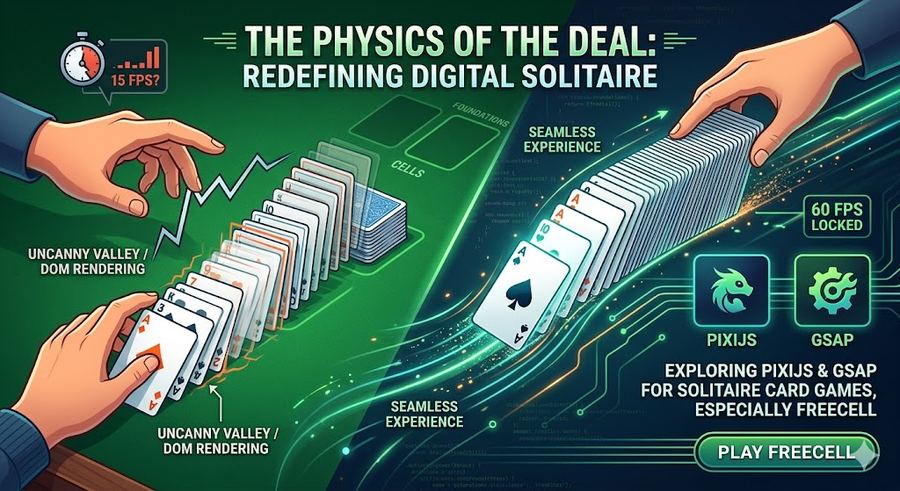
If you are a high-volume Solitaire player, you already know the feeling of the "uncanny valley" in digital card games. You click a cascading stack of cards, drag it toward a foundation pile, and something just feels fundamentally wrong. The cards ghost across the screen, the frame rate stutters during complex moves, and the final release feels floaty and imprecise. It lacks the visceral, tactile snap of actual pasteboard hitting green felt.
Most digital Solitaire reviews and development blogs focus entirely on rule variations, daily challenges, or the visual aesthetics of the card faces. But the reason your favorite browser-based game feels clunky isn’t a lack of features or poor graphic design; it is a critical flaw in its underlying rendering engine.
Before we dive into the mathematics and rendering architecture that fix this, you need a baseline. To immediately understand the difference between a legacy game and a modern, hardware-accelerated engine, you can play this FreeCell right now. Notice how the cards bind instantly to your cursor and how they carry physical momentum.
That specific, flawless kinetic feel is not an accident. It is the result of modern game developers discarding conventional, generalized web frameworks. Instead, they are turning to a highly specialized, hyper-performant tech stack: PixiJS paired with GSAP (GreenSock Animation Platform).
Here is the uncompromising technical reality of why this specific software pairing is engineering the ultimate experience for serious players, and why the era of DOM-based card games is officially obsolete.
The Problem: Why 52 Cards Break the Browser Pipeline
To truly understand why PixiJS and GSAP are revolutionary for web-based games, we first have to examine the browser rendering pipeline and why traditional methodologies fail so spectacularly under pressure.
When a Solitaire game is built using standard HTML and CSS, every single card is treated as an individual DOM (Document Object Model) element-usually a <div> or an <img> tag. When you click and drag a stack of four cards across the tableau, the browser cannot simply move a picture. It must continuously push through a multi-step pipeline: Recalculate Style, Layout, Paint, and Composite.
For every single frame of your drag, the browser recalculates the CSS properties for every element. If those cards have complex styling, such as CSS drop shadows or rounded borders-which are visually necessary to differentiate overlapping cards-the browser is forced to constantly repaint the screen.
In standard architecture, this triggers a catastrophic, endless cycle known as "layout thrashing." The browser’s main thread becomes severely bottlenecked trying to render 52 individual elements, manage their overlapping z-indexes, and paint their complex mathematical shadows at a target of 60 frames per second.
Furthermore, standard JavaScript garbage collection often kicks in during these intensive DOM operations. When the CPU pauses to clear memory, it causes unpredictable micro-freezes. As a result, the input latency spikes. The cards stop sticking tightly to your cursor and start trailing lazily behind it. For a game like FreeCell-where rapid, precise moves, algorithmic thinking, and sheer speed dictate your psychological flow state-this micro-stutter shatters the illusion.
PixiJS: Escaping the Main Thread via WebGL
PixiJS solves the layout thrashing problem by doing something radical: bypassing the browser’s DOM entirely. PixiJS is an advanced 2D rendering engine that leverages WebGL (Web Graphics Library) to offload the visual heavy lifting directly to your device's GPU (Graphics Processing Unit). It speaks directly to the hardware.
Instead of treating 52 cards as 52 complex HTML documents that the browser's CPU has to parse and render, PixiJS treats them as hardware-accelerated sprites. For a seamless rendering experience, PixiJS utilizes a critical technique called texture atlasing.
In this workflow, all 52 card faces, the intricate card backs, and various UI elements are tightly packed into a single, highly optimized image file (a sprite sheet) and loaded directly into the GPU’s VRAM upfront. When you deal a game of FreeCell, PixiJS isn’t asking the browser to draw 52 separate images from your hard drive or network. Instead, it executes a single, highly efficient "draw call" to the GPU, mapping coordinates from the texture atlas directly to the screen via WebGL shaders.
The result is absolute, uncompromising visual lock. You can drag a massive cascading stack across the screen, and the GPU handles the matrix transformations in a fraction of a millisecond. The main thread is left completely pristine to handle the actual mathematical game logic-validating complex moves, calculating win states, and tracking precise timers. By divorcing the underlying game logic from the visual rendering pipeline, PixiJS permanently eliminates the input lag that has plagued browser-based Solitaire for over a decade.
GSAP: The Mathematics of the "Snap"
If PixiJS provides the raw, unadulterated horsepower of a sports car, GSAP provides the finely tuned suspension and physics engine.
Moving a card from a FreeCell reserve to the tableau isn't just a simple change in X and Y coordinates. In physical reality, a card accelerates as it leaves your fingers, encounters minute air resistance, and decelerates abruptly as it hits the felt, resulting in a satisfying, kinetic "snap."
Traditional web animations rely on basic CSS transitions or rudimentary requestAnimationFrame loops governed by linear interpolation. This makes digital cards feel lifeless, like they are sliding on frictionless ice. GSAP is an industry-standard, robust JavaScript animation library built on complex mathematical easing curves and precise timeline control.
When a game is engineered with GSAP, moving a card triggers sub-pixel rendering and custom mathematical easing equations:
- Anticipation, Scale, and Weight: As you click and hold a card, GSAP doesn't just change its coordinates. It can instantly scale the sprite up by exactly 2.5% and dynamically increase the opacity and spread of its drop shadow using a Power2.easeOut curve. This provides the immediate optical illusion of the card being physically lifted off the two-dimensional table toward the player's eye.
- Friction, Trajectory, and Snap: When you release the card over a valid foundation, GSAP doesn't just teleport it to the new column. It calculates a micro-trajectory in real-time. Using an easing function like Back.easeOut(1.2), it accelerates the sprite and then sharply decelerates it precisely into its slot, allowing for a microscopic, 1.2% "overshoot" before settling. This perfectly mimics the physical friction of a card slapping against the deck. GSAP binds directly to the PixiJS ticker, ensuring these physics calculations update perfectly in sync with the monitor's native refresh rate.
The FreeCell Stress Test
FreeCell is the ultimate, grueling stress test for this technology stack because of its defining mechanic: the "Super-Move."
In standard Solitaire (Klondike), you generally move one or two cards at a time. In FreeCell, if you have enough empty cascading columns and empty reserve cells, the game's rules allow you to move an entire sequence of deeply nested cards at once. Logically, the game engine is executing multiple individual card transfers in the background. Visually, however, the player expects to pick up a massive stack of alternating colors as a single, cohesive unit.
In a DOM-based engine, moving a large stack causes severe z-index flickering. The browser struggles to determine which <div> sits on top while they are all in motion, causing the cards to literally fight for rendering priority on the screen.
PixiJS handles z-depth sorting natively through strictly managed WebGL container hierarchies, ensuring the visual integrity of the stack never breaks, regardless of velocity. Meanwhile, GSAP ensures that if the massive stack is released on an invalid pile, it snaps back to its origin in a smooth, cascading ripple effect. Instead of the whole stack teleporting, GSAP sequences the return-each card flying back sequentially with a 0.05-second micro-delay-creating a beautiful, fluid ribbon effect rather than a jarring jump cut.
The Takeaway
As players, we often passively internalize bad software as an inevitable part of playing games in a web browser. We grudgingly accept the stuttering card drags, the massive laptop battery drain caused by layout thrashing, and the floaty, lifeless animations.
But the modern convergence of WebGL and dedicated kinetic animation platforms proves that browser-based card games can-and absolutely should-rival the performance and tactile satisfaction of compiled, native desktop applications.
The difference between a legacy HTML game and a WebGL-based game is not purely aesthetic; it is deeply psychological. When a game reacts flawlessly and instantly to your rapid inputs, delivering the precise visual weight, momentum, and friction you unconsciously expect from physical reality, the digital interface simply disappears. You are no longer fighting the limitations of the DOM; you are just purely playing the game.
🔙 Back to Articles list.