New Gaming Technology in 2026: AI Graphics, Unreal Engine 5 and Beyond
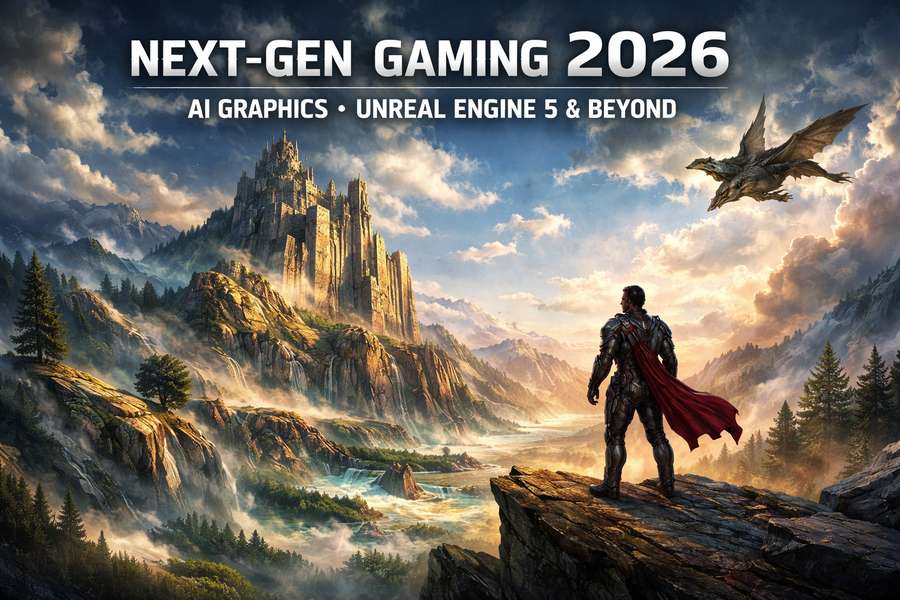
2026 turned out to be the year gaming tech actually started feeling like it lived up to all the talk from 2023-2025. AI graphics aren't some "coming soon" thing anymore - they're in the games you're playing today, cleaning up path-traced noise, filling in details the engine can't afford to render fully, making 4K/60 feel normal even on consoles. Unreal Engine 5 is basically the only engine most big studios bother with anymore - Nanite lets them use insane polygon counts without LOD pop-in, Lumen makes light bounce naturally without lightmaps or probes. Throw in DLSS 5, PSSR on PS5 Pro, faster SSD streaming, dynamic physics, spatial audio, and suddenly games don't just look better - they feel like real places you could step into. While you're waiting for the next patch, trailer, or benchmark leak, arcadspot is still the perfect quick break - classic games, instant load, no hype, just jump in and play for a few minutes.
AI Graphics: Denoising to Neural Rendering
AI graphics in 2026 do real work, not just upscaling. DLSS 5's Ray Reconstruction takes noisy path-traced frames and cleans them in one pass - fixes artifacts that used to ruin shots, guesses photoreal detail when the ray count is low. NVIDIA's Tensor Cores in the 50-series got a big boost, so path tracing at 4K/60+ with frame generation feels smooth instead of "wow, it kinda works." On consoles, PS5 Pro's PSSR does something similar - sharpens images, adds frames, makes high-res look clean without that soft, blurry feel you used to get from upscaling. Neural rendering is the next level: AI fills in entire parts of the scene, not just pixels. Distant objects get smarter detail, backgrounds look less flat, devs can push more rays and effects without dropping to 30 fps. It's already in titles like Resident Evil Requiem (dark corridors look clean), Crimson Desert (distant mountains stay sharp). The best part? It lets devs take risks with lighting and geometry without worrying about performance tanks. You can actually see the difference side-by-side in games that support it - old ray tracing looks "good but layered," new AI-enhanced path tracing looks cohesive and expensive.
Unreal Engine 5: The Engine That Took Over Everything
UE5 is the default in 2026 for a reason. Nanite lets devs use infinite geometry detail - cliffs, cities, forests look sharp up close without LOD swaps or performance hits. You can walk right up to a rock wall and see every crack and bump. Lumen gives dynamic global illumination - light bounces realistically without baking or probes, so moving a lamp or opening a door actually changes the room. Layer path tracing on top, and UE5 games have lighting that feels cinematic: sunlight through windows casts soft colored patterns, neon signs tint walls, dark corners get natural fill. No more fake artist-placed lights everywhere to hide flaws. Most open-world and story-driven games run on it or something very close - it's free, powerful, and the results are hard to beat. Even smaller studios are jumping on it because the tools are accessible and the output is insane. You can tell a UE5 game from a mile away now - the detail just holds up when you stop and look around.
Console and GPU Upgrades
PS5 Pro finally got the attention it needed - PSSR upscaling + frame generation let path-traced effects run smooth at higher res without looking soft. RTX 50-series brought massive efficiency gains for ray tracing and AI workloads - 2-4× better than 40-series in heavy scenes. SSDs got even faster for streaming huge worlds without hitching or texture pop-in. Dynamic weather, physics destruction, spatial audio - it all ties together so environments feel reactive and heavy. Games don't just look better; they feel more responsive because loading is instant and detail streams seamlessly. The gap between PC and console is smaller than ever - you can get close to high-end PC visuals on PS5 Pro with the right settings. Devs are starting to target both platforms with the same level of detail, which is new.
Standout Examples in 2026
GTA VI uses an upgraded RAGE engine with heavy ray tracing and AI-enhanced details - wet streets reflect the whole city, neon interiors glow naturally, crowds react to light and sound. Crimson Desert leans on UE5 for path-traced bounce lighting in forests and caves - sunlight through canopy, accurate indoor firelight. Resident Evil Requiem makes horror terrifying with flashlight bounce off blood and wet floors, moonlight diffusion through fog. 007 First Light uses full path tracing for cinematic spy scenes - MI6 offices and tropical villas lit like a movie. Yandere simulator free is still floating around as a weird cult download - people grab it for the meme and the creepy obsession vibe, but it's a reminder that not every game needs next-gen graphics to stick in your head or leave a mark. Sometimes a simple idea with obsessive detail beats photorealism.
What's Coming Next
AI graphics will keep evolving - neural rendering might generate entire backgrounds or details with almost no artist input in the next few years. UE5 updates will make Nanite and Lumen even better - more detail, more dynamic light, better performance. VR/AR gets closer to real life with path-traced lighting matching your room - objects feel solid, reflections blend perfectly, motion sickness drops. Consoles will keep closing the gap with PC - more AI upscaling, more frame gen, smarter streaming. The bar is already high - games that don't at least try for this level of realism will feel dated fast. 2026 wasn't the peak; it was the starting line for what's coming. If you're into this stuff, the next few years are going to be wild - buckle up.
🔙 Back to Articles list.